

Continuous Improvement & Program Evaluation
At Kaiser Permanente San Jose Psychiatry Residency, continuous improvement is not a behind-the-scenes accreditation exercise. It is one of the ways we live our values as a learning community. Our program actively reviews resident and faculty feedback, clinical learning experiences, curriculum, wellness, diversity and inclusion, scholarly activity, graduate outcomes, and the overall learning environment so that we can identify what is working, name what needs attention, and make meaningful changes over time.
How the Program Listens, Decides, and Improves
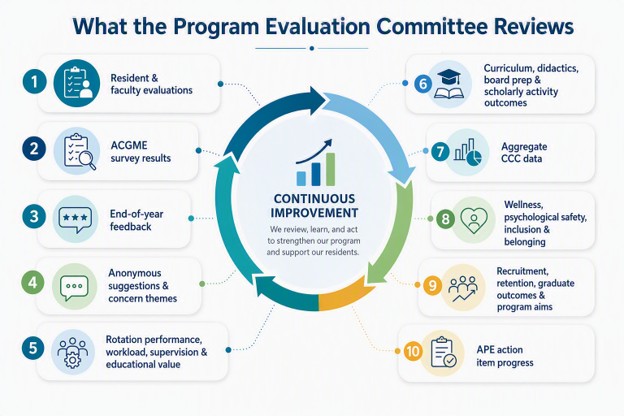
The Program Evaluation Committee, or PEC, is the residency’s central structure for program improvement. The PEC includes program leadership, faculty, program administration, chief residents, and resident representatives. It meets regularly to review data, identify themes, recommend changes, and track progress on action items. In short, the PEC is how the program listens, decides, and improves.
From Feedback to Action
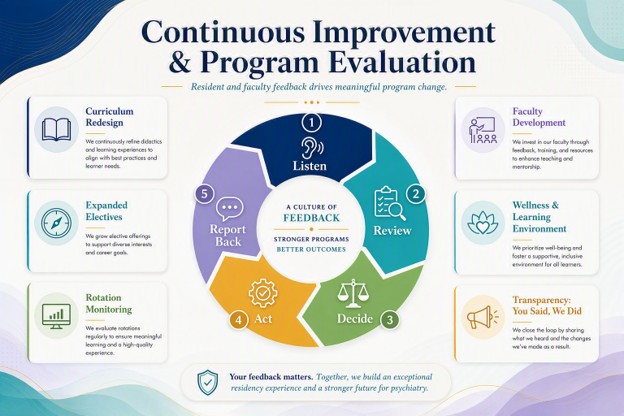
Feedback is most meaningful when residents and faculty can see what happens next. The PEC reviews themes across evaluations and surveys, translates those themes into action items, assigns owners and timelines, and monitors progress through the year. When an issue requires additional work, the PEC partners with the Education Committee, Wellness Committee, IDEA Committee, Scholarly Activity leadership, Clinical Competency Committee, site directors, and program leadership to develop a targeted plan.
Continuous Improvement in Action: Examples of Program Progress
Resident and Faculty Voice
Residents and faculty are essential partners in program improvement. Resident representatives serve on PEC and other standing committees, including Education, Wellness, IDEA, and Scholarly Activity. Residents may raise ideas or concerns through class representatives, chief residents, program leadership, evaluations, surveys, anonymous reporting pathways, and direct conversation with faculty mentors or program leaders. Faculty also participate in evaluation, committee work, curriculum development, supervision improvement, and feedback processes.
PEC Committee Members
Faculty
- Brooke Harris, PhD — Chair
- Lih-Chiao Hsu, MD – Adult Outpatient and Geriatric Psychiatrist
- Shawn Jin, MD – Child and Adolescent Psychiatrist
- Suhail Sheikh, MD – Assistant Program Director
- Zhongshu Yang, MD, PhD – Program Director
Resident Representatives
- Sam J. Rashkovich, MD — Class of 2029
- Benny Escobedo, MD — Class of 2028
- Emily Chen, MD — Class of 2028
- Theodora Kipers, MD — Class of 2028
- Matthew Tran, MD — Class of 2027
- Asees Waraich, MD — Chief Resident, Class of 2027
- Elizaveta Souboch, MD — Chief Resident, Class of 2027
Psychological Safety and Confidentiality
Because program evaluation includes sensitive feedback, the PEC emphasizes confidentiality, respect, psychological safety, and data-informed discussion. Committee discussions focus on themes and patterns rather than individual criticism. The goal is to make it possible for residents and faculty to speak candidly, raise concerns without fear of retaliation, and participate in shared accountability for a better learning environment.
Annual Program Evaluation
Each year, the PEC produces the Annual Program Evaluation, which summarizes the state of the residency, reviews progress on prior action items, identifies strengths and areas for growth, and sets priorities for the coming academic year. The Annual Program Evaluation helps ensure that program improvement is organized, measurable, transparent, and connected to the residency’s mission and aims.